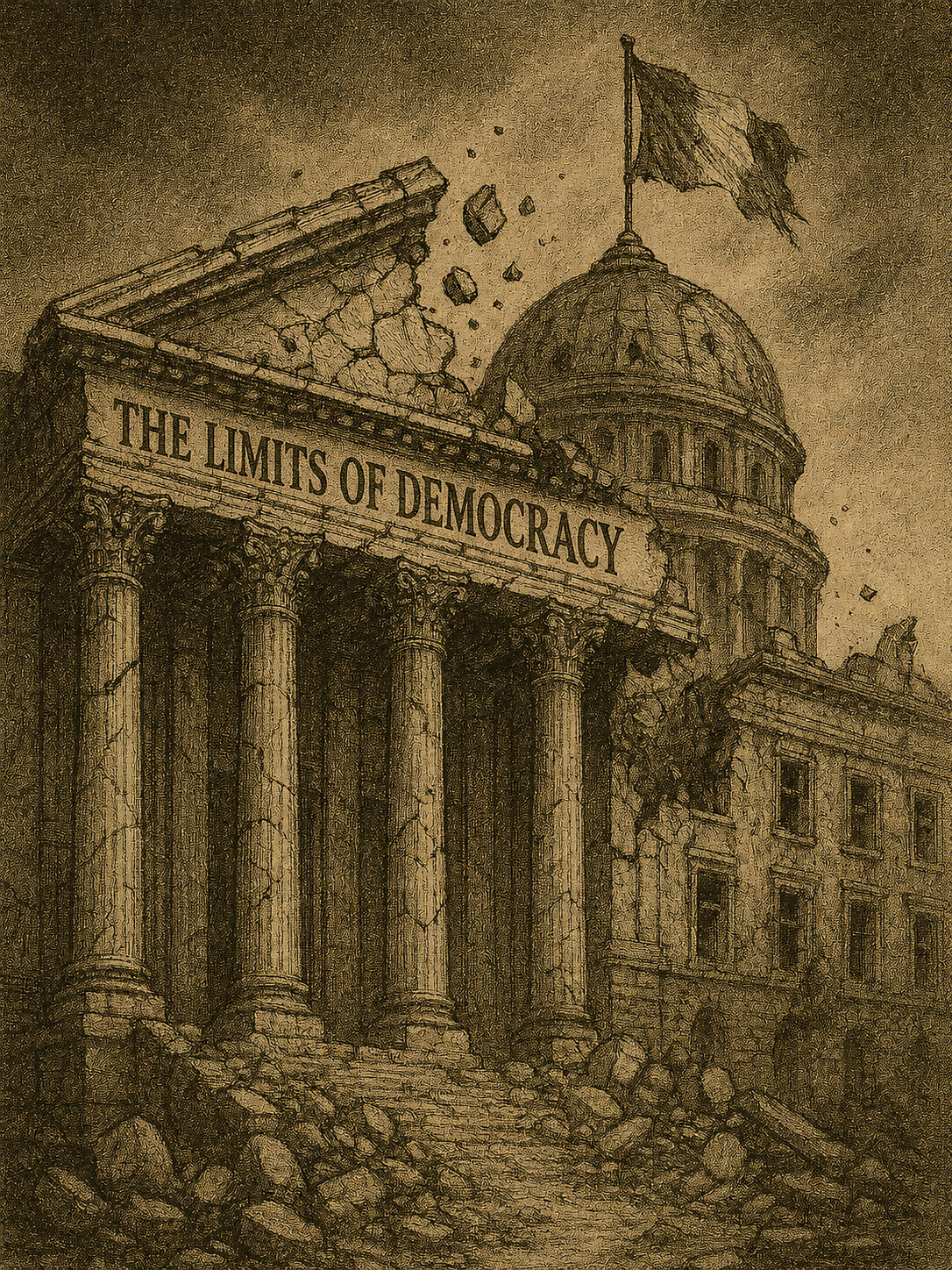


Condensed open-access version of the book The Limits of Democracy, published on Amazon — a matured reflection, fed by the many riots that brought to the surface the questions to which this essay is a response.
The recurring spectacle of capitals going up in flames for various pretexts, images travelling around the world and foreign figures commenting on them as a warning, is not a succession of isolated incidents. It is the symptom of a much deeper illness. The pretext is only the spark; the dryness accumulated over decades explains the fire. And that fire can only be understood by tracing its causes: a 2005 referendum rejected by 54.68% of voters and then bypassed through Parliament three years later, twenty years without any national popular consultation in the self-proclaimed homeland of human rights, and the gradual installation of an elective oligarchy in which the people are summoned only to ratify choices already made elsewhere.
This essay proposes to examine that tension rigorously, without complacency, and to put forward concrete paths for institutional refoundation. It is the free, condensed version of the book The Limits of Democracy, available in its extended version on Amazon.
What this analysis contains
The essay is structured in five parts and draws on reference academic work: Paul Lazarsfeld and the Columbia school, Daniel Gaxie, Céline Braconnier and Jean-Yves Dormagen, Dimitri Courant, Francis Fukuyama, Yascha Mounk, Jason Brennan, Jonathan Rauch, Philippe Braud, Marcel Gauchet, Pierre Rosanvallon, Dominique Schnapper, Pierre Manent and many others.
It begins with a brutal question: can a democracy democratically destroy itself? The answer is no longer theoretical. It is visible in the way political systems can be paralyzed by demagoguery, by clientelism, by the fear of reform, by riots, by fiscal fatigue, by the degradation of education, by the capture of public debate and by the inability to impose long-term decisions.
The analysis then examines the French case: the bypassed 2005 referendum, the disconnection between rulers and citizens, the abstention of the working classes, the overrepresentation of protected groups, the power of organized minorities, the weakness of direct democracy, and the inability of the current institutional order to produce a genuine mandate for rupture.
Democracy is not abolished by recognizing its limits
To say that democracy has limits is not to reject the people. It is to refuse the childish idea that a vote, by itself, can sanctify every collective decision. A people can be misinformed, exhausted, manipulated, clientelized, frightened or bought with its own debt. A political system can remain formally democratic while no longer allowing the nation to choose its destiny.
The issue is therefore not to replace democracy with tyranny. It is to rebuild a democracy capable of defending itself against lies, irresponsibility, debt, administrative decomposition and the organized capture of public consent.
What institutional refoundation would require
A serious refoundation would require more than a change of faces. It would require clear referendums that cannot be bypassed, a stronger hierarchy of responsibility, a profound simplification of the State, a real evaluation of public spending, civic education rebuilt from the ground up, the end of institutional cowardice in the face of violence, and mechanisms ensuring that those who decide are accountable for the consequences of their decisions.
The purpose is not to make democracy weaker, but to make it adult again. A mature democracy must be able to hear the people without worshipping every impulse, to protect minorities without submitting to organized intimidation, to debate without lying, to vote without surrendering sovereignty to networks of influence.
Why this essay now?
Because France has reached the point where the question can no longer be avoided. The system no longer convinces, no longer protects, no longer reforms, and no longer assumes responsibility. If democratic institutions are unable to correct themselves, others — markets, streets, violence, or external constraints — will eventually do so in their place.
The real democratic urgency is therefore not to pretend that everything is fine. It is to ask how a nation can regain the power to decide without destroying the liberties it claims to defend.