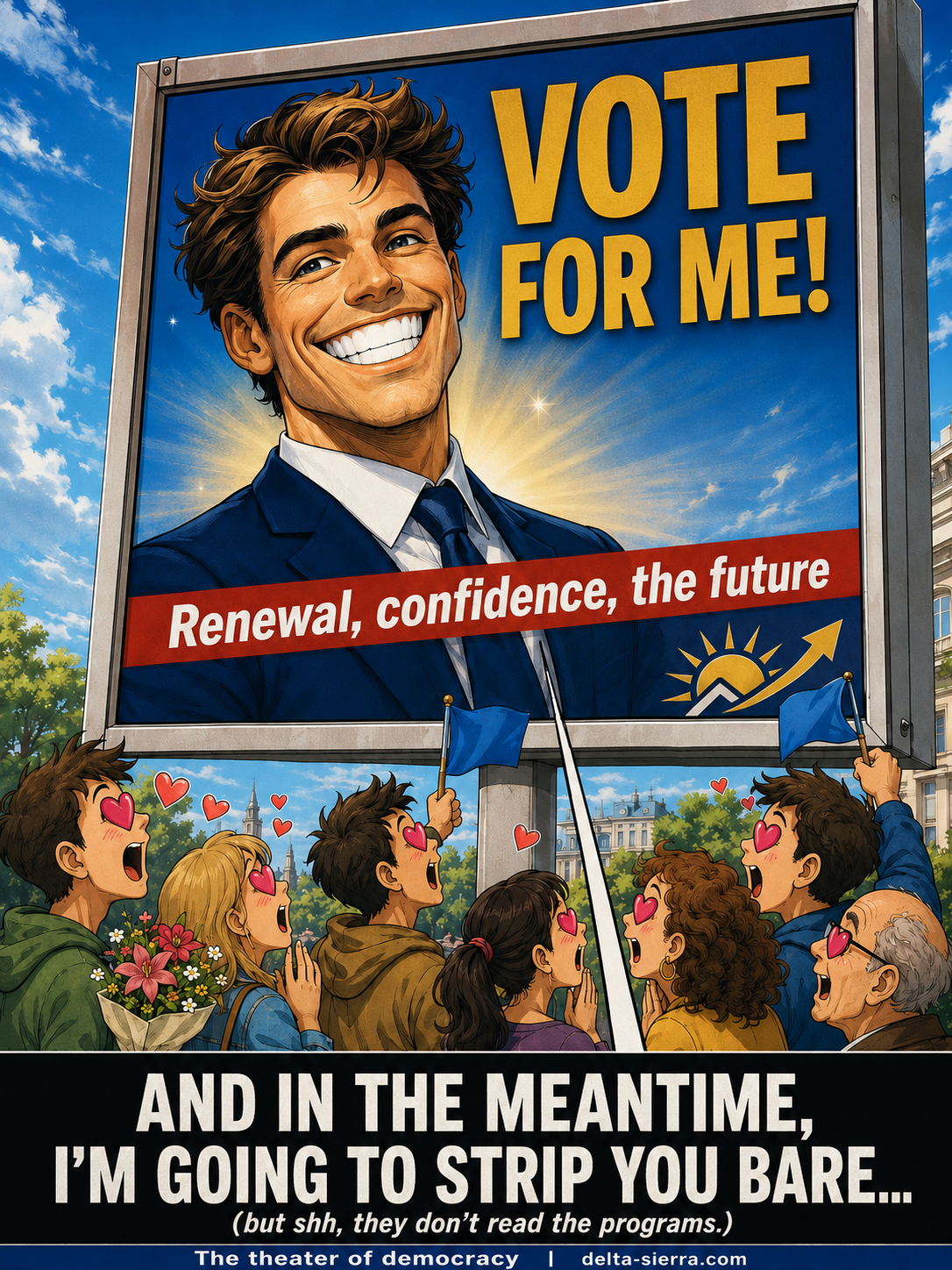


An open-access analysis of one of the most fragile mechanisms of representative democracy: the gap between what candidates show and what they actually put in their programs.
The image illustrating this analysis is not a caricature. It is a barely exaggerated representation of what our current electoral system produces: a bright smile, a vague slogan, a crowd caught in emotional excitement, and at the bottom, in very small print, what almost no one reads — the real program, meaning what the candidate truly intends to do once elected.
This gap between campaign staging and the reality of governing is not an accident. It has become a structural mode of operation in modern representative democracies, and it raises a fundamental question as France moves toward the 2027 presidential election.
The finding: reading programs is collapsing
Successive studies of electoral behavior point in the same direction: the share of voters who actually read candidates’ programs before voting is marginal. Most choices are made on other criteria: sympathy for the candidate, physical appearance, speaking ability, media positions on a few emblematic issues, the influence of one’s social circle, or opposition to an adversary perceived as worse.
The program — the written document that commits the candidate to what he or she will do if elected — is largely short-circuited. It exists formally, it is sometimes printed and distributed, but it is no longer the main support of electoral decision-making.
Why the program no longer determines the vote
Several factors converge. First, serious programs have become long and technical. They deal with taxation, pensions, defense, energy, immigration, education and dozens of other subjects in administrative and legal vocabulary that many citizens find impenetrable.
Second, the media environment favors speed, conflict and image. A good line, a viral clip or a symbolic posture often weighs more than a 200-page program. Third, political communication has adapted to this reality: it sells affect, proximity, personality and narrative before it sells a coherent plan.
The democratic risk
If citizens vote primarily on impressions while the real program remains unread, democratic consent becomes fragile. The elected official can then claim a mandate for measures that many voters never understood, never read or never really approved. The campaign becomes a theatrical mask placed over the substance of power.
This does not mean citizens are stupid. It means the system is designed to exploit limited attention. Modern political marketing knows that emotion moves faster than analysis.
What should be restored
A serious democracy should force clarity. Programs must be shorter, comparable, costed, summarized and legally traceable. Major commitments should be presented in a standardized format. Contradictions, hidden costs and unrealistic promises should be publicly identified before the vote.
Above all, voters must be encouraged to judge not only a face or a mood, but a trajectory. Democracy cannot remain healthy if the image wins the election and the fine print governs the country.