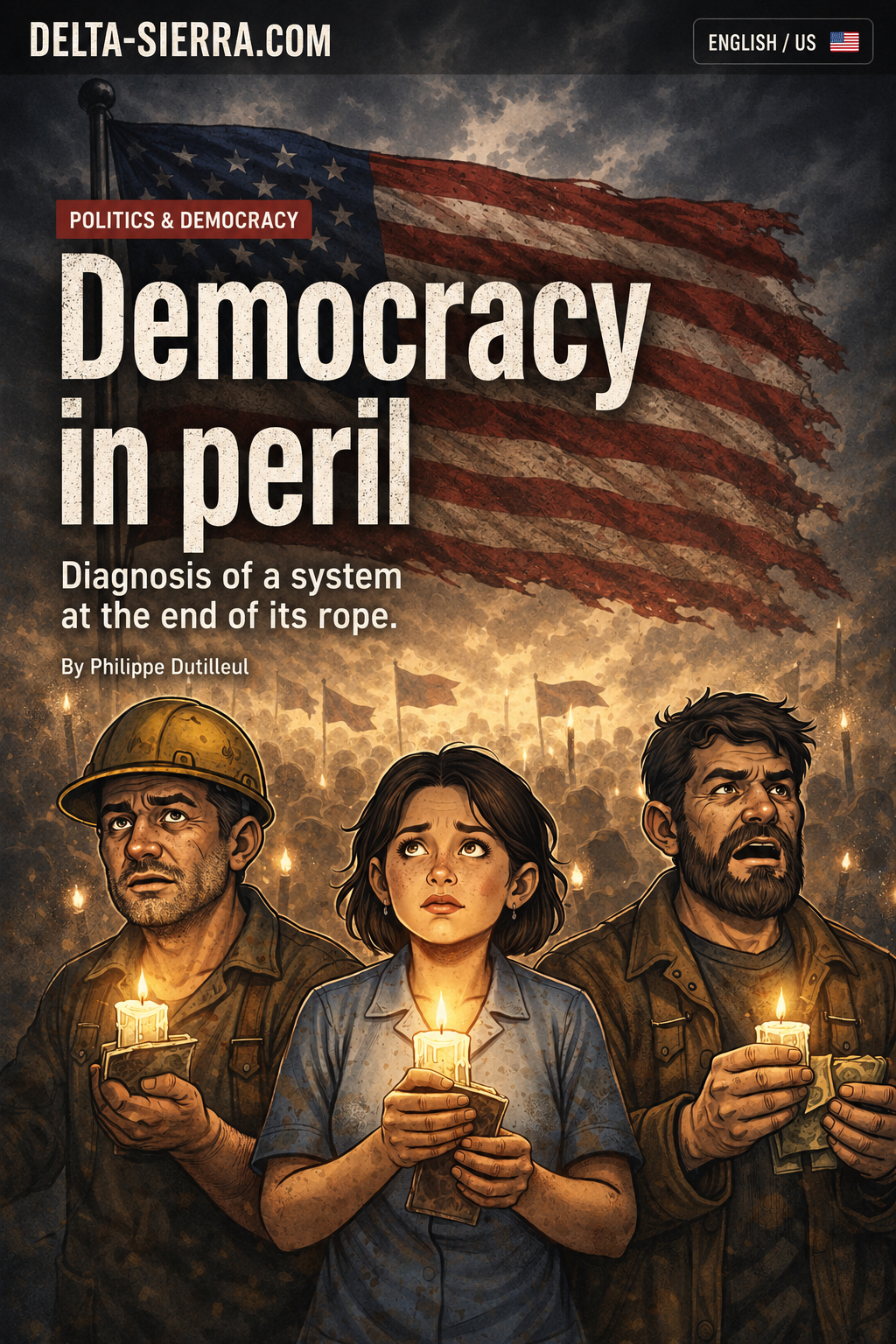


Democracy in peril: when institutions no longer correct themselves
A democracy does not collapse only when tanks enter the streets or when a dictator abolishes elections. It can also decay slowly, while keeping its rituals, its vocabulary and its official ceremonies. Elections continue. Speeches continue. Institutions continue to function. Yet the people feel that decisions are no longer truly theirs.
This is the danger facing France: a democracy that still organizes votes, but increasingly fails to transform popular will into political action.
The fracture between the people and the system
The fracture did not appear in a single day. It was built through repeated disappointments: promises not kept, referendums bypassed, reforms imposed without clear mandate, public services deteriorating despite record taxation, and an administrative machine that seems more concerned with preserving itself than serving citizens.
When citizens vote and nothing changes, they stop believing in the usefulness of voting. When they protest and are treated as a problem to be managed rather than as a signal to be understood, they radicalize or withdraw. When they are asked to finance a State that no longer protects them efficiently, consent weakens.
Representative democracy has become too comfortable for those who live from it
One of the major defects of the current system is the distance between decision-makers and consequences. Political leaders can vote measures whose effects will be borne by others. Administrations can impose rules without experiencing their cost. Institutions can multiply procedures without being evaluated on the damage they cause.
This is how irresponsibility becomes structural. Everyone participates in the decision, but no one is truly accountable when the result fails.
The role of fear, emotion and media staging
Modern democracy is increasingly governed through emotion. A shocking image, a slogan, a media storm or a moral panic can displace long-term reasoning. Public debate becomes reactive. The urgent replaces the important. The appearance of compassion replaces serious policy. The performance of firmness replaces actual authority.
In such a climate, citizens are not invited to deliberate; they are pushed to react.
Can democracy save itself?
Yes, but only if it stops confusing procedure with legitimacy. A decision is not automatically just because it passed through an institution. A policy is not automatically democratic because elected officials approved it. Legitimacy requires understanding, consent, responsibility and the possibility of correction.
Democracy must therefore be rebuilt around clearer mechanisms: referendums that cannot be bypassed, real accountability for public spending, institutional simplification, stronger civic education, transparency about consequences, and the restoration of a direct link between the vote and the direction of the country.
The choice ahead
The real danger is not the criticism of democracy. The real danger is refusing to see that democracy can become empty from within. A people that no longer believes it can influence its destiny eventually looks elsewhere: abstention, anger, rupture, authoritarian temptation or social explosion.
To defend democracy seriously is not to repeat slogans about it. It is to repair the conditions that make it credible.